Back when we still lived in Washington D.C., Susan and I frequently repeated a similar conversation. She would walk into our apartment after a work event or some other nighttime activity and say something like, “I had the nicest cab driver. He grew up in Mumbai. Moved here when he was twenty-two. His father owns that Indian place on Fifteenth Street. His kids are in sixth and eighth grade at Hardy Middle School. He and his wife are going back to India this summer for their twentieth anniversary…” This would often go on for another five minutes.
My cabbie experiences always went like this: “Where ya going.”
“4500 Tunlaw Road.”
Cue stony silence for twenty-three minutes.
“That’ll be $7.20.” (Yes, seven bucks. This was twenty-some years ago).
In general, people don’t talk to me. I’m not complaining, I don’t actually want to talk with anyone, but it seems strange that no one ever approaches me and starts a conversation. Maybe they pick up on my I-don’t-wanna-talk-to-you vibe, but I doubt it. I think the problem is I just don’t look friendly. My face sits in a perpetual frown. Resting Bitch Face? I’ve got it.
Not long ago, in a meeting at work, we were supposed to go around the room and give personal feedback to the other employees. People mostly kept it upbeat and positive. When my turn came, one employee, a woman in her mid-thirties, said I was ‘scary.’
In a meeting last Friday, someone mentioned that I never smile. My peers at work are librarians, and I happened to be sitting near a couple of children’s librarians. Suddenly they both started talking about a picture book called The Pout-Pout Fish by Deborah Diesen. One of them quoted the book. “I’m a pout-pout fish with a pout-pout face, so I spread the dreary-wearies all over the place.” I swallowed my annoyance and responded kindly, but I doubt I ever smiled.
In my next meeting, my boss Miranda also told me to smile. I suppose I must have looked especially bitter that day, but in my defense, I had a very rough Tourette week that included a day off work due to uncontrollable tics. I hadn’t fully recovered from that. I have a great relationship with Miranda, and I can tell her anything. “Man, I hate it when people tell me to smile.” I told her about the dreary-wearies discussion from the previous meeting. Miranda, also a librarian, started into a praising summary about The Pout-Pout Fish as well.
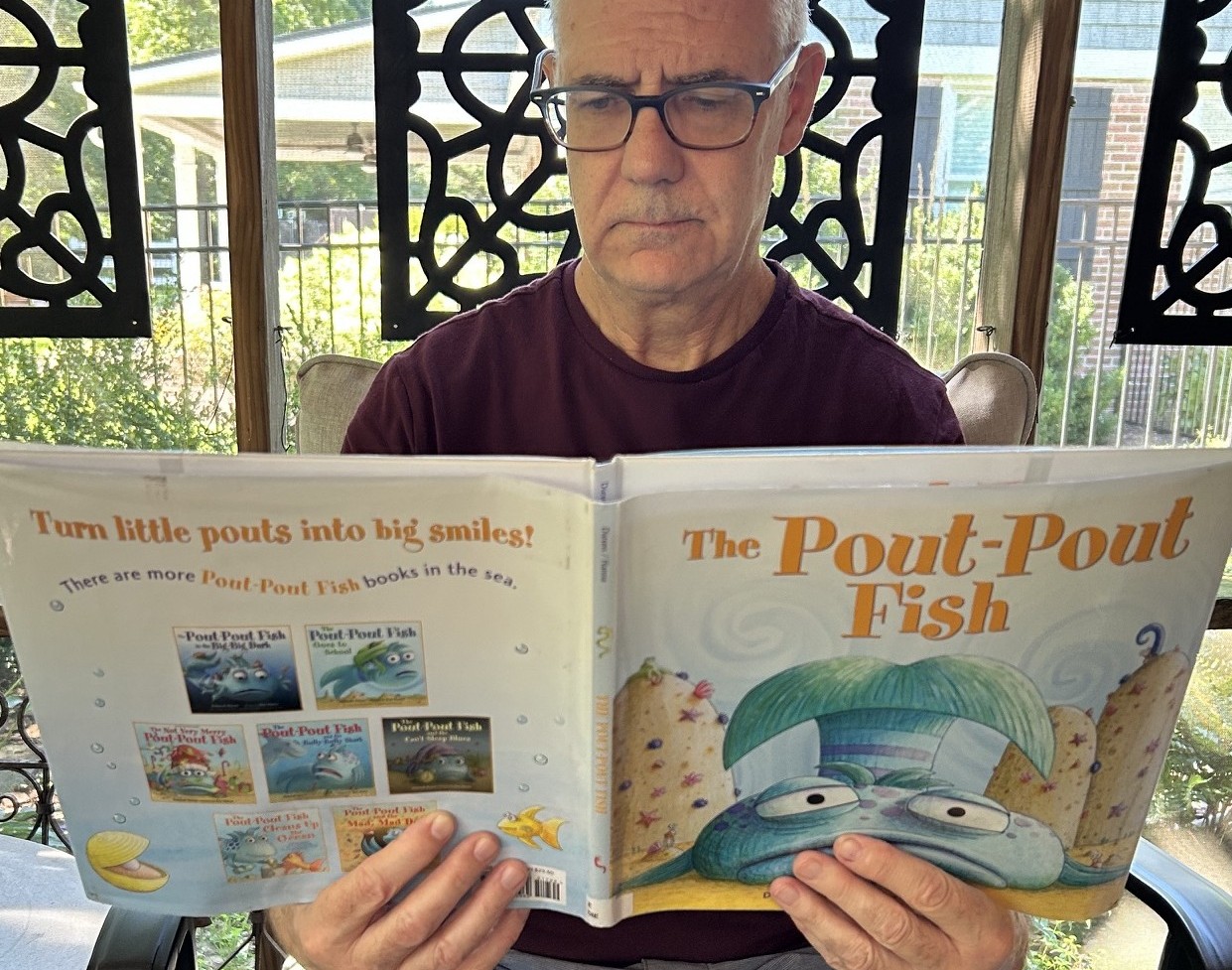
When my meetings were over, Miranda, emailed me a screenshot of The Pout-Pout Fish cover with the message ‘check it out.’ I went to the children’s room and pulled a copy from the shelf and sat at a tiny table with tiny chairs to read it. I was self-conscious that the employee at the children’s circulation desk might be thinking, ‘Oh thank God he’s reading that book. He’s worse than the pout-pout fish himself.’
In the book, the pout-pout fish encounters a series of sea creatures—a clam, a jellyfish, a squid, and an octopus. Each one speaks a clever rhyme that in its own way insists the pout-pout fish put on a smile. They tell him he’s bringing everybody else down. The pout-pout fish responds that this is just the way he is. It’s his nature, and he can’t force himself to smile.
‘Yes!’ I thought. ‘This is the point of the story. We need to accept our friends for who they are. We don’t need to put on fake smiles to make others happy.’ As a neurodiverse adult with Tourette Syndrome and possibly co-occurring autistic tendencies, the admonishments over my non-expressive face that I’ve heard my entire life do nothing but make me feel bad about myself. To teach young children that it isn’t appropriate to scold others into smiling is a gift to all of society.
My joy was short lived. On the very next page, a girl fish swoops in and gives the pout-pout fish a kiss on his mouth. This kiss causes the pout-pout fish smile uncontrollably. And that’s when I learned the real message of the book: someone else always knows what’s best for you, and if they can make you act like everyone else, they should. Because that’s the real goal of society, to force people to act how you want them to act and not to let them be themselves.
And luckily the pout-pout fish learned the lesson well. On the following pages, he swims all over the ocean kissing other creatures on the mouth without consent. At the end of the book, all the sea creatures are happy, and the children who read the book now understand that neurological differences can easily be corrected by doing to others the one thing you would want done to yourself.
So next time you see someone with a frown walking down the street, be sure to tell them to smile. You’ll be improving their life in ways they cannot fathom. And if that doesn’t work, you probably ought to give them a kiss.
 The Other Stuff
Jeff, you are brilliant. Thanks for the delightful humor that skillfully highlights some of the ridiculously insensitive ways humans can be with one another. Love it.
LikeLike